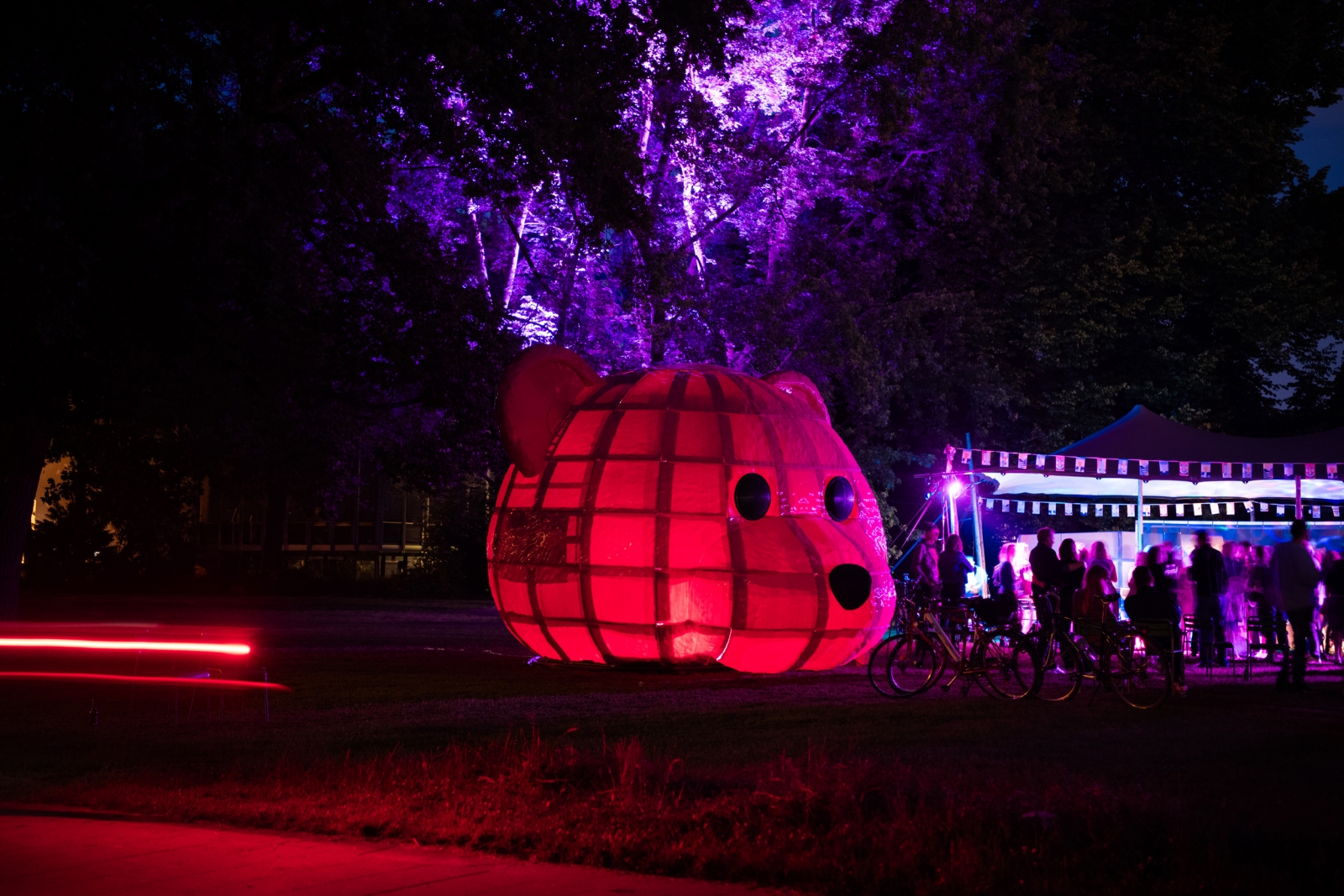
The Pink Bear Pavilion transformed one of LUAP’s most personal recurring symbols into a monumental, inhabitable sculpture. Rising four metres from the landscape at Altonaler Balkon in Hamburg, the work enlarged The Pink Bear beyond the scale of the body, allowing visitors to physically enter the character and move into an interior space conceived as a place of refuge, introspection and connection.
Constructed from approximately 2,500 kilograms of recycled plastic around a timber structure, the Pavilion shifts between sculpture, architecture and psychological space. Its playful, immediately recognisable exterior gives way to a quieter interior, reflecting the contradictions that have followed The Pink Bear throughout LUAP’s practice: visibility and concealment, innocence and experience, protection and vulnerability.
The Pink Bear originated as a figure connected to LUAP’s childhood memories and later became a means of examining mental health, identity and the internal landscapes we carry with us. Across painting, photography, performance and sculpture, the character has moved between the role of protagonist, companion and alter ego. The Pink Bear Pavilion extends this language into architecture, turning an image normally viewed from the outside into a space that can be physically inhabited.
The work began with a six-centimetre plasticine model made by LUAP before being developed over two years into a structure measuring approximately four metres high, five metres wide and six metres long. Enlarged to this scale, the familiar proportions of a childhood toy become monumental. The relationship between viewer and character is reversed: rather than looking at The Pink Bear, the viewer becomes small enough to step inside it.
This change in scale is central to the work. Entering the Pavilion evokes the altered proportions of childhood, when objects, rooms and imagined worlds could feel vast. LUAP uses this shift in perspective to return the viewer momentarily to a state in which the boundary between reality and imagination is less fixed. The monumental head becomes both physical shelter and mental landscape, as though the viewer is entering not simply the form of The Pink Bear, but its mind.
The exterior carries the immediacy associated with The Pink Bear throughout LUAP’s work. Its colour and scale make it highly visible within the landscape, yet the interior moves in the opposite direction. It offers enclosure, creating a quieter space separated from the activity beyond its walls. This tension between being seen and what remains internal runs throughout LUAP’s practice. The Pink Bear can appear outwardly joyful and reassuring while simultaneously holding ideas of anxiety, isolation, memory and emotional survival.
Inside the Pavilion, works by LUAP and twelve graduating artists from the University of Europe for Applied Sciences were projected across the internal surface of the sculpture. Rather than operating as a conventional gallery, the interior became a changing visual environment in which individual works appeared within the larger psychological space of the bear. The Pavilion therefore functioned not only as an object in itself, but as a structure capable of containing other voices and experiences.
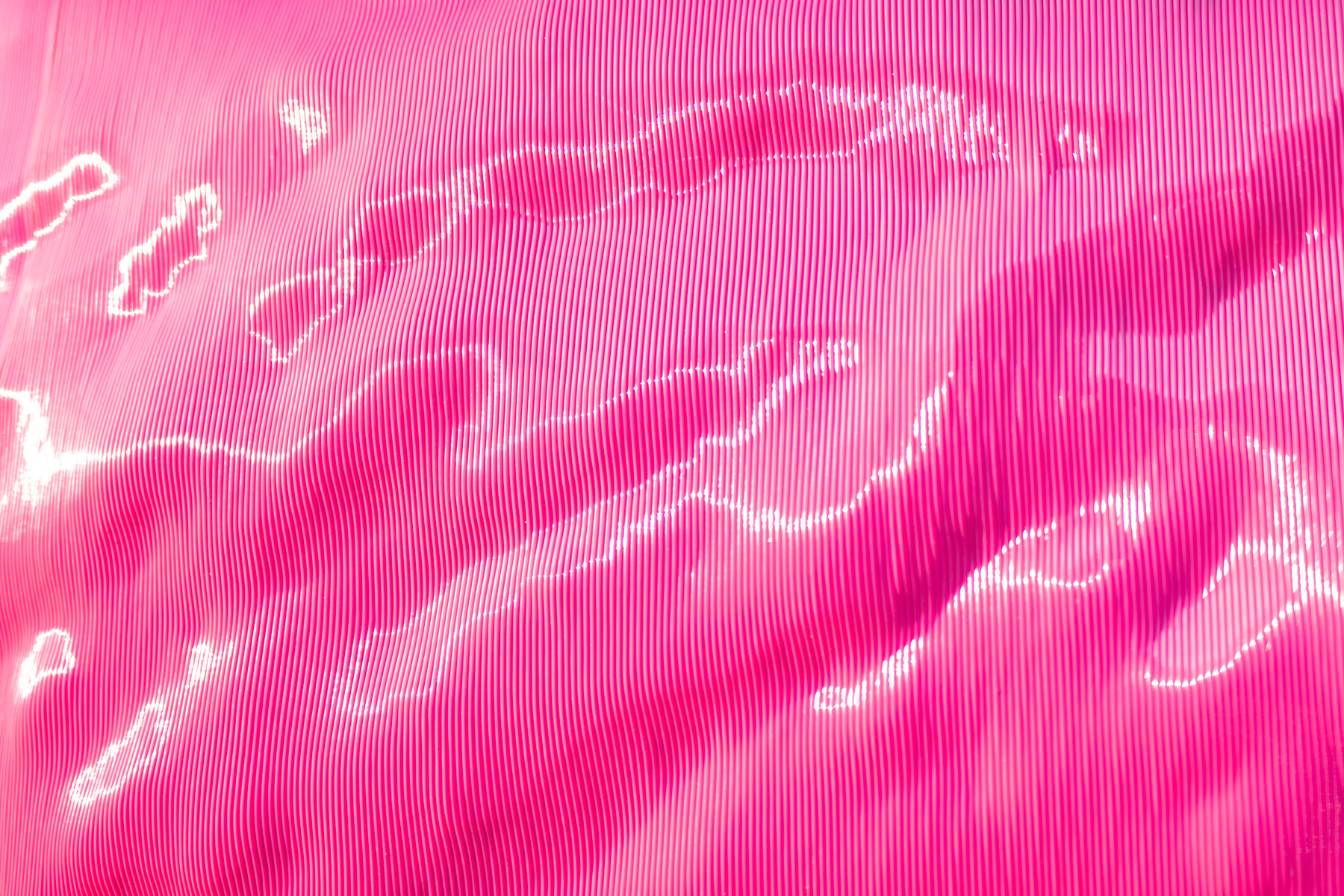
Material is equally important to the work. Approximately 2,500 kilograms of recycled plastic were formed through large-scale robotic 3D printing and assembled around an engineered timber structure. The resulting surface retains evidence of its method of construction, giving the enormous head a physical presence very different from the soft object it represents. Something associated with comfort and touch is reconstructed through industrial processes, producing a tension between familiarity and strangeness.
The material also introduces another layer to the sculpture. A vast quantity of discarded plastic is transformed into an object whose apparent softness and innocence contradict its physical mass. Rather than disguising the material, the Pavilion makes that accumulation tangible. Its scale allows an otherwise abstract quantity to be understood through the body: visitors walk around it, stand beneath it and eventually enter it.
For LUAP, The Pink Bear has always occupied a space between the real and the imagined. It has been carried into mountains, deserts, forests and abandoned landscapes, placing an improbable figure within real environments. The Pavilion reverses this process. Instead of taking The Pink Bear into an existing landscape, LUAP creates the landscape inside The Pink Bear.
At this scale, a private symbol becomes collective without losing its personal origin. Visitors encounter the sculpture differently: as a surreal interruption in the landscape, an architectural object, a place to gather or a temporary refuge. Yet beneath these experiences remains the psychological function that first gave The Pink Bear meaning within LUAP’s work: a protective presence through which difficult emotions can be approached indirectly.
The Pink Bear Pavilion marks an expansion of LUAP’s practice from representation into inhabitable form. Painting, photography, sculpture and architecture converge around a single recurring figure, while the boundary between artwork and viewer becomes increasingly porous. By allowing people to enter the work itself, LUAP turns The Pink Bear from something observed into something experienced, creating a physical space in which memory, vulnerability, imagination and connection can coexist.